Summary
The largest Indian state by population, by multiplex count, and by exhibition infrastructure has the smallest box office among India's major language film industries. In 2024, Marathi cinema grossed ₹177 cr against Tamil's ₹1,829 cr, Telugu's ₹2,348 cr, and Malayalam's ~₹1,180 cr — one-tenth, one-thirteenth, and one-seventh of those markets respectively.
Raja Shivaji — Riteish Deshmukh's historical epic, made on the largest budget in Marathi cinema's history — is on course to touch ₹100 cr and is already the third-highest-grossing Marathi film ever. It is an exception, not a turnaround. The 2022–23 cycle (Pawankhind, Har Har Mahadev, Ved, Baipan Bhari Deva) sparked similar hopes, and the industry contracted 46% in 2025 to ₹96 cr.
Four structural flaws explain the gap: over-dependence on a handful of films, weak star-led openings, a long tail of one-time producers, and a sub-par marketing and release strategy. None are new. None have been addressed.
Raja Shivaji is doing what Marathi cinema almost never does
Twenty days after its Maharashtra Day release, Riteish Deshmukh's Raja Shivaji has crossed ₹81 cr at the domestic box office (Marathi and Hindi versions combined) and is on course to touch the ₹100 cr mark. Made simultaneously in Marathi and Hindi on a budget reported between ₹75 cr and ₹100 cr, it is the most expensive Marathi film ever made, and is already the third-highest-grossing Marathi film of all time. For an industry that, in a typical year, struggles to put even one film past the ₹30 cr mark, this is a genuinely large moment.
It is also — and this is the part the industry should sit with carefully — an exception. Step back from the headlines, look at the actual scale of the Marathi film business over the last six years, and a much more uncomfortable picture emerges.
Maharashtra's market should be one of the largest. It isn't.
Maharashtra has roughly 12.5 cr people today. That makes it larger than Tamil Nadu, larger than Karnataka, larger than the combined population of Andhra Pradesh and Telangana, and roughly three-and-a-half times the size of Kerala. It also has the highest number of multiplex screens of any state in India — more than Tamil Nadu, more than the Telugu states, far more than Kerala. By every input metric — addressable audience, screen access, urbanisation, disposable income — Maharashtra should anchor one of the largest theatrical markets in the country.
It doesn't. Here is how Marathi cinema's 2024 box office compares to the four southern industries that address smaller populations on similar (or weaker) screen infrastructure.
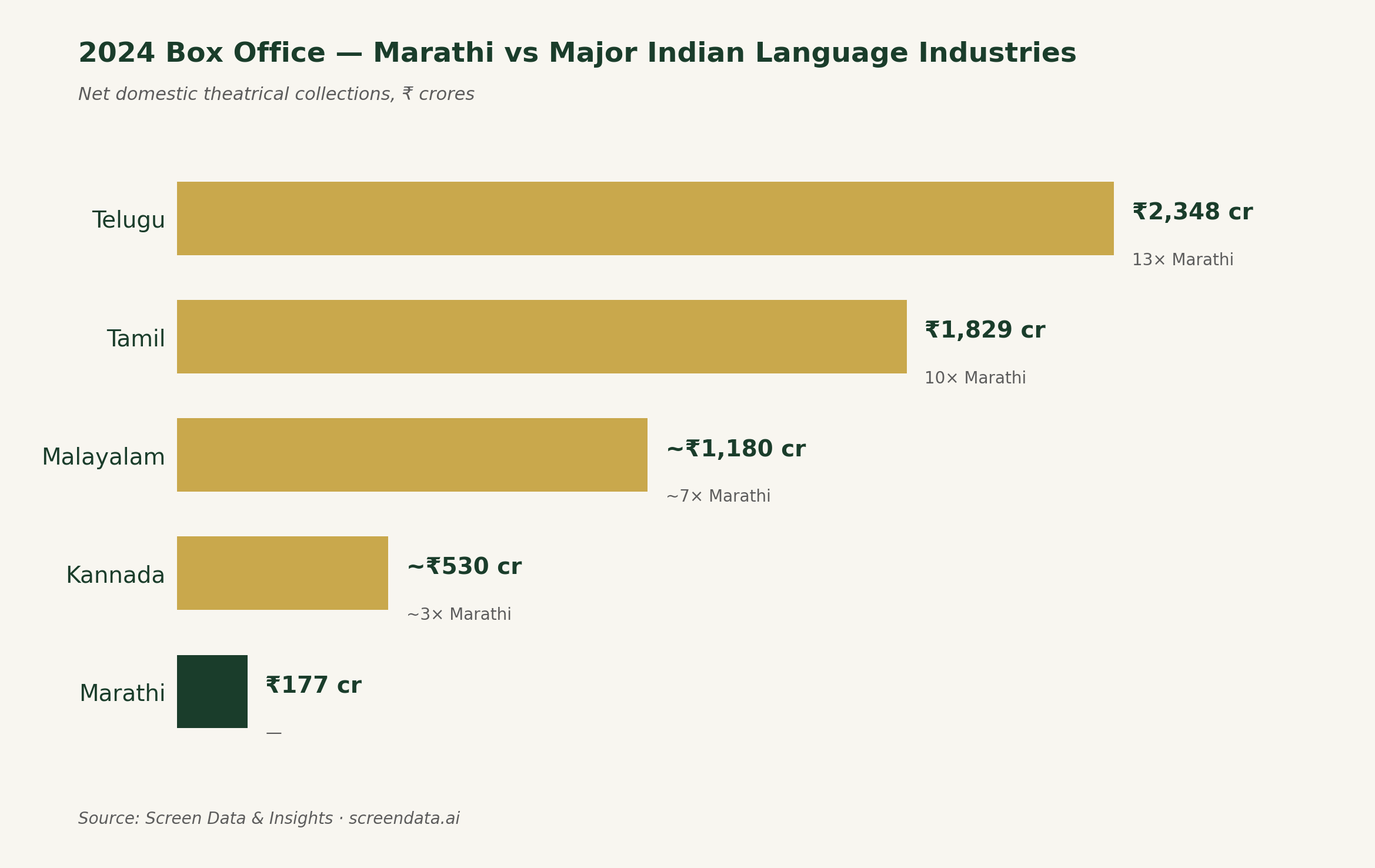
Telugu does 13 times Marathi's annual gross with three-quarters of Marathi's audience. Tamil does 10 times. Malayalam — addressing barely a quarter of Maharashtra's population — does nearly seven times. Even Kannada, the smallest of the major southern industries by collection, is roughly three times Marathi's size on roughly half the audience. This is not a small gap. It is the difference between a language market that has scaled and one that has not.
And 2024 was actually a normal year for Marathi. Look at the trendline:
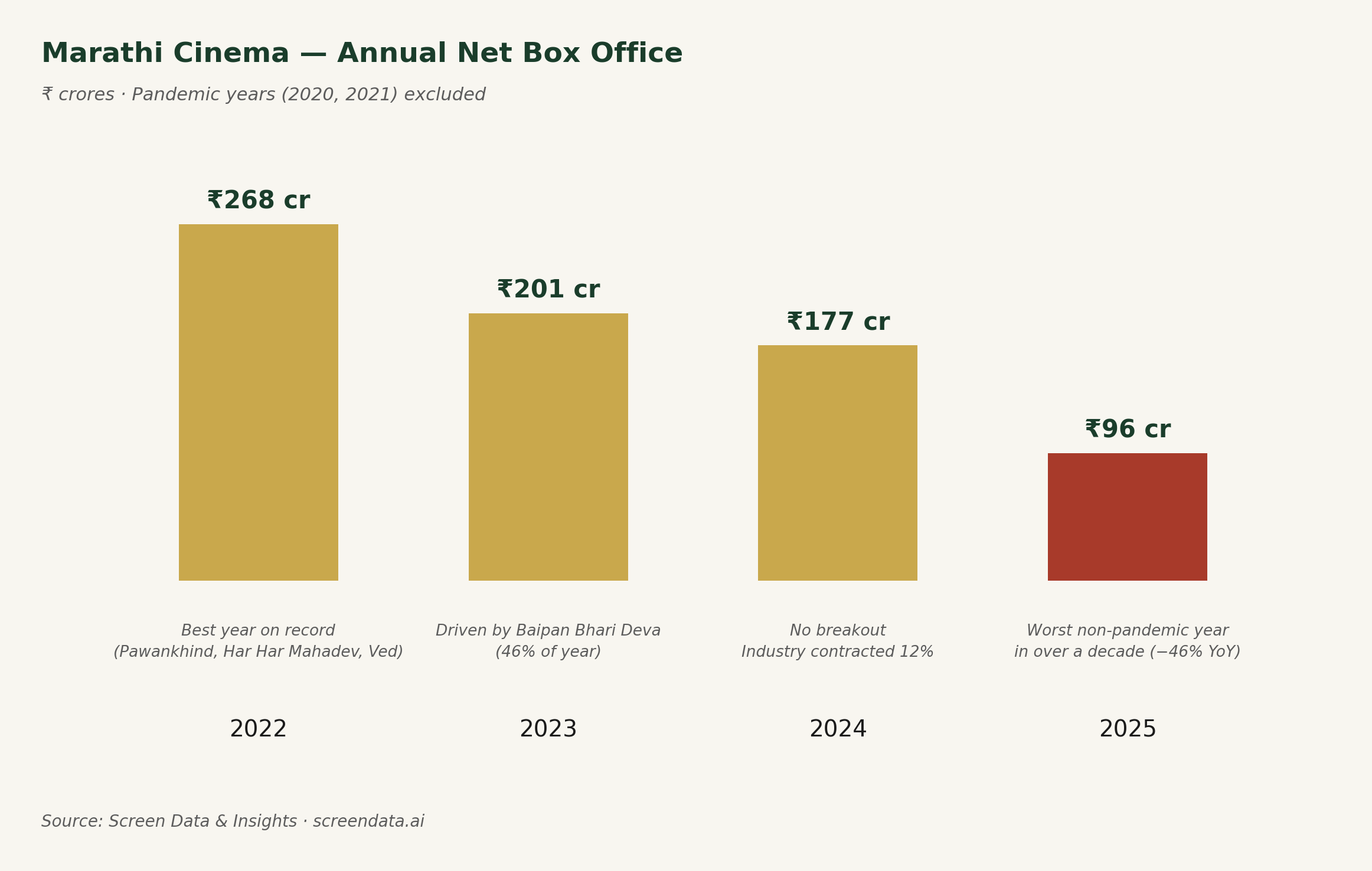
2022 — Marathi cinema's best year on record — was the output of three specific films (Pawankhind, Har Har Mahadev, and a December release of Ved). 2023's ₹201 cr was driven by Baipan Bhari Deva alone contributing 46% of the year's total. 2024 had no breakout, and the industry contracted 12%. 2025 collapsed 46% to ₹96 cr — the worst non-pandemic year in over a decade.
Raja Shivaji will lift 2026's number meaningfully. But it will not fix what the rest of the year looks like underneath it. That requires understanding why the gap with the south exists in the first place. Four reasons.
1. Over-dependence on a handful of films
In Tamil and Telugu, the top 10 films typically account for 60–65% of the year's box office. In Malayalam, that number is closer to 45%. In Marathi, it has consistently been 75–80% — and worse in some years. In 2023, a single film (Baipan Bhari Deva) was 46% of the entire industry's collections. In 2022, three films were the lion's share of a ₹268 cr year. In 2024, with no breakout, the top film maxed out at ₹23.5 cr net and the industry shrank by ₹24 cr.
The Marathi box office does not have a long tail; it has a thin spike. Years where the spike happens look fine. Years where it doesn't, the industry contracts by a third or more. This makes the business structurally fragile in a way the southern markets simply are not. A Telugu or Tamil producer can underwrite a slate against a known base of mid-budget films that do reliable business. A Marathi producer cannot.
2. Limited star power, and almost no opening-day insurance
Stars in Tamil, Telugu, Malayalam, and Kannada build careers predominantly in films. The screen is their primary medium, and the audience treats their releases as events. Marathi cinema doesn't work this way. Most leading Marathi actors run parallel careers across television, theatre, and now streaming — diluting the exclusivity of seeing them on the big screen. Riteish Deshmukh is the exception, and Raja Shivaji's numbers reflect what genuine star-event positioning can do when it actually happens.
The everyday reality is different. Films featuring the most popular Marathi stars routinely open below ₹50 lakh on day one. There is no Vijay or Rajinikanth equivalent in Marathi, no Yash, no Mohanlal or Mammootty, no Allu Arjun. And the next generation has not emerged either — there is no Marathi face of the same scale and youth appeal as a Vijay Deverakonda, a Dulquer Salmaan, or a Rishab Shetty. The result: a Marathi producer cannot pre-sell an opening weekend on a star name, no matter how popular. Every Marathi film is, in effect, a content gamble.
3. A long tail of one-time producers
Marathi cinema has the most fragmented producer base of any major Indian language. Two studios — Zee Studios and Viacom 18 (Jio Studios since the merger) — produce a meaningful slate. Beyond them, the industry is overwhelmingly populated by first-time and one-off producers. In the four-year window leading up to the pandemic, of 263 unique producers who released a Marathi film, 251 had produced only one. The fragmentation has continued through 2022–25.
Why this matters: a first-time producer cannot match a studio on the things that decide a film's commercial fate — slate economics, media tie-up leverage, marketing depth, exhibitor relationships. The relatively low cost of producing a Marathi film (budgets are a fraction of what an equivalent Tamil or Telugu film would cost) lowers the entry barrier and continually pulls in newcomers — but the same factor caps the marketing and release-quality ceiling. The industry is over-supplied at the production end and under-resourced at the distribution end. That is precisely the wrong combination.
4. Sub-par marketing and release strategy
The supply-demand mismatch is the most visible part of this. Marathi cinema releases roughly 100–125 theatrical films a year — a number close to what Tamil and Telugu release, but addressed to a fraction of their theatrical audience. The result is week after week of three, four, or even five Marathi films opening on the same day, all competing for the same handful of screens and the same audience attention.
Because there is no time, no money, and often no studio behind the average Marathi release, marketing collapses to a one-week trailer-to-release window, minimal media presence outside Marathi GEC promos (which favour studio-backed releases anyway), and almost no buzz-building outside Maharashtra. Films that don't open in their first weekend disappear; films that open are then forced onto streaming within weeks because there is no time to build word-of-mouth at the box office. Audiences, in turn, learn to wait — which weakens the next weekend's openings further. This loop has hardened over the last three years.
Raja Shivaji is, in part, a proof that the loop can be broken. A genuinely big budget, a national-scale star, a Maharashtra Day release, an A-list marketing campaign and a Hindi-language version that opens up the addressable audience — and the film is on course to touch ₹100 cr. That recipe is replicable. But the industry has produced perhaps three or four films at this scale in the last decade. Until that pipeline broadens, every other Marathi release will continue to play out in the conditions described above.
The Raja Shivaji moment, and the work after
It would be easy, on the back of Raja Shivaji's box office, to declare a Marathi revival. The 2022–23 cycle (Pawankhind, Har Har Mahadev, Ved, Baipan Bhari Deva) prompted similar declarations, and the industry collapsed back to ₹96 cr in 2025. One film, or even three, do not change the structure of an industry.
Maharashtra has the audience. It has the screens. It now has the proof, again, that Marathi cinema can monetise that audience at scale when the right film is put in front of them.
The four flaws above are the reason this proof remains rare instead of routine. They are also, all four of them, solvable. The question is whether the industry treats Raja Shivaji as a culmination or as a beginning.